Autors:
Sergi BalariTítol:
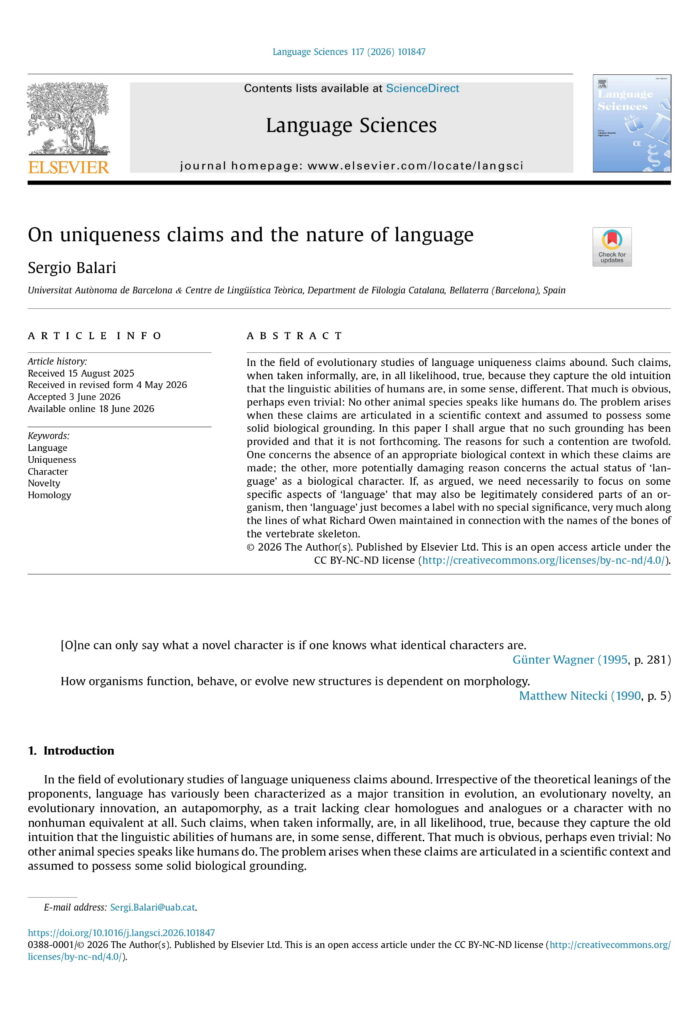
On uniqueness claims and the nature of languageEditorial: Language Sciences 117
Col·lecció: Language Science
Data de publicació: Setembre 2026
Més informació
Abstract
In the field of evolutionary studies of language uniqueness claims abound. Such claims, when taken informally, are, in all likelihood, true, because they capture the old intuition that the linguistic abilities of humans are, in some sense, different. That much is obvious, perhaps even trivial: No other animal species speaks like humans do. The problem arises when these claims are articulated in a scientific context and assumed to possess some solid biological grounding. In this paper I shall argue that no such grounding has been provided and that it is not forthcoming. The reasons for such a contention are twofold. One concerns the absence of an appropriate biological context in which these claims are made; the other, more potentially damaging reason concerns the actual status of ‘language’ as a biological character. If, as argued, we need necessarily to focus on some specific aspects of ‘language’ that may also be legitimately considered parts of an organism, then ‘language’ just becomes a label with no special significance, very much along the lines of what Richard Owen maintained in connection with the names of the bones of the vertebrate skeleton.Keywords
Language ; Uniqueness ;Character ;Novelty ;Homology