Autors:
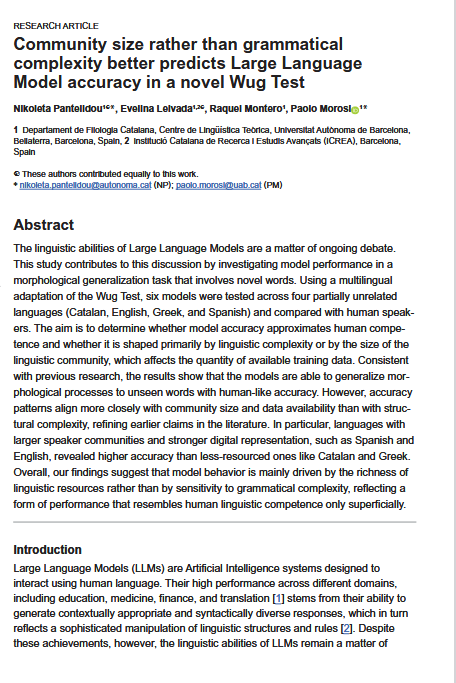
Pantelidou, Nikoleta, Evelina Leivada, Raquel Montero, Paolo MorosiTítol:
Community size rather than grammatical complexity better predicts Large Language Model accuracy in a novel Wug TestEditorial: PLoS One 21(3)
Col·lecció: PLoS One
Data de publicació: 2026
Text complet
Abstract
The linguistic abilities of Large Language Models are a matter of ongoing debate. This study contributes to this discussion by investigating model performance in a morphological generalization task that involves novel words. Using a multilingual adaptation of the Wug Test, six models were tested across four partially unrelated languages (Catalan, English, Greek, and Spanish) and compared with human speakers. The aim is to determine whether model accuracy approximates human competence and whether it is shaped primarily by linguistic complexity or by the size of the linguistic community, which affects the quantity of available training data. Consistent with previous research, the results show that the models are able to generalize morphological processes to unseen words with human-like accuracy. However, accuracy patterns align more closely with community size and data availability than with structural complexity, refining earlier claims in the literature. In particular, languages with larger speaker communities and stronger digital representation, such as Spanish and English, revealed higher accuracy than less-resourced ones like Catalan and Greek. Overall, our findings suggest that model behavior is mainly driven by the richness of linguistic resources rather than by sensitivity to grammatical complexity, reflecting a form of performance that resembles human linguistic competence only superficially.
Citation: Pantelidou N, Leivada E, Montero R, Morosi P (2026) Community size rather than grammatical complexity better predicts Large Language Model accuracy in a novel Wug Test. PLoS One 21(3): e0343164. https://doi.org/10.1371/journal.pone.0343164
Editor: Wei Lun Wong, National University of Malaysia Faculty of Education: Universiti Kebangsaan Malaysia Fakulti Pendidikan, MALAYSIA
Received: October 16, 2025; Accepted: February 2, 2026; Published: March 11, 2026
Copyright: © 2026 Pantelidou et al. This is an open access article distributed under the terms of the Creative Commons Attribution License, which permits unrestricted use, distribution, and reproduction in any medium, provided the original author and source are credited.
Data Availability: All data files are available from the OSF database (https://osf.io/4z5n6/).
Funding: EL acknowledges funding from the Spanish Ministry of Science, Innovation & Universities MCIN/AEI/https://doi.org/10.13039/501100011033) under the research project CNS2023-144415. The funders had no role in study design, data collection and analysis, decision to publish, or preparation of the manuscript.
Competing interests: The authors have declared that no competing interests exist.