3 febrer, 2018
Autors:
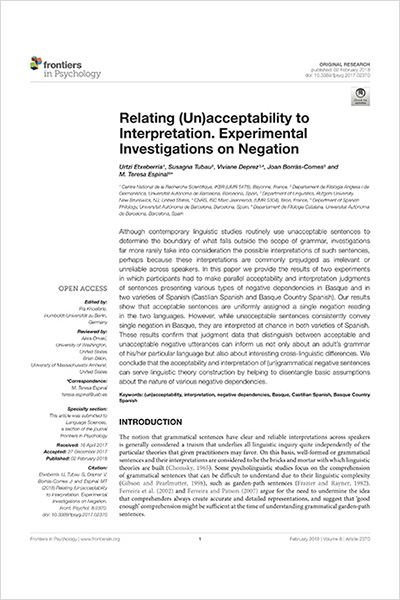
Urtzi Etxeberria, Susagna Tubau, Viviane Deprez, Joan Borràs-Comes and M. Teresa Espinal
Títol:
Relating (Un)acceptability to InterpretationEditorial: Frontiers in Psychology
Col·lecció: Frontiers in Psychology #8Data de publicació: 2018
Més informació
Text completAlthough contemporary linguistic studies routinely use unacceptable sentences to determine the boundary of what falls outside the scope of grammar, investigations far more rarely take into consideration the possible interpretations of such sentences, perhaps because these interpretations are commonly prejudged as irrelevant or unreliable across speakers. In this paper we provide the results of two experiments in which participants had to make parallel acceptability and interpretation judgments of sentences presenting various types of negative dependencies in Basque and in two varieties of Spanish (Castilian Spanish and Basque Country Spanish). Our results show that acceptable sentences are uniformly assigned a single negation reading in the two languages. However, while unacceptable sentences consistently convey single negation in Basque, they are interpreted at chance in both varieties of Spanish. These results confirm that judgment data that distinguish between acceptable and unacceptable negative utterances can inform us not only about an adult’s grammar of his/her particular language but also about interesting cross-linguistic differences. We conclude that the acceptability and interpretation of (un)grammatical negative sentences can serve linguistic theory construction by helping to disentangle basic assumptions about the nature of various negative dependencies.
Títols de la col·lecció / Also in this series:
3 març, 2021
Autors:
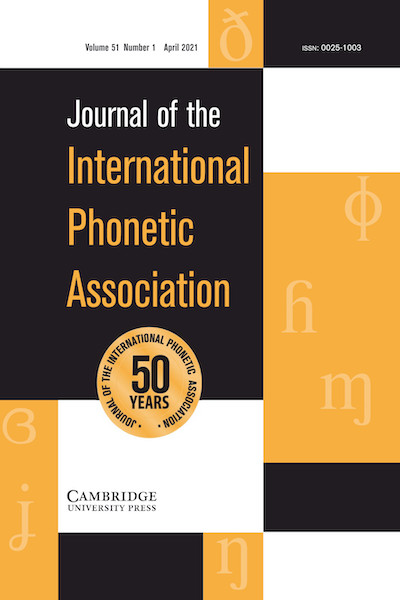
Daniel Recasens
Títol:
Acoustic characteristics and placement within vowel space of full schwa in the world's languages: A surveyEditorial: Journal of the International Phonetic Association, Cambridge University Press
Data de publicació: 3 de març del 2021
Més informacióData from about one hundred languages reveal that, in spite of resulting typically from articulatory reduction of peripheral vowels in unstressed position, full schwa may also occur in stressed position in stress languages and in unreduced syllables in languages lacking stress. Formant frequency data reveal that this vowel is mid central, though somewhat shifted to the mid back unrounded area (particularly if long and placed in open syllables and at the edges of words), and exhibits a higher or lower realization depending on the number of mid vowels in the vowel system. In spite of occurring in stressed position, full schwa resembles unstressed schwa in being very short, highly variable and possibly low intensity, which accounts for why it is prone to occur in closed syllables and longer words, and may receive stress only if the remaining vowel nuclei in the word are central and/or short peripheral. Moreover, variability in the F1 and F2 dimensions increases with the number of peripheral mid vowels, which appears to obey symmetry and dispersion principles of vowel space organization.
4 abril, 2021
Autors:
Elena Pagliarini, Marta Andrada Reyes, Maria Teresa Guasti, Stephen Crain & Anna Gavarró
Títol:
Negative sentences with disjunction in child Catalan, Language Acquisition 2021Editorial: Routledge
Data de publicació: Gener del 2021
ISBN13: 1048-9223
Més informacióIn English, the sentence Mary didn’t eat pizza or sushi is assigned the neither interpretation (both disjuncts must be false). In Mandarin Chinese, the equivalent sentence is assigned the at least one interpretation (at least one disjunct must be false). The cross-linguistic variation in the interpretation of negative sentences with disjunction has been attributed to the Disjunction Parameter. On one value of this lexical parameter, disjunction is a Positive Polarity Item (+PPI). On the other value, disjunction is not a Positive Polarity Item (-PPI). According to the Semantic Subset Principle (SSP), all child language learners are predicted to initially assign the neither interpretation to negative disjunctive sentences, for reasons of language learnability. The present study investigates the interpretation of negative sentences with disjunction in Catalan. The findings confirm that disjunction is +PPI for adults; children show a bimodal distribution. For some children, disjunction is -PPI, as predicted by the SSP. However, some children adopt the adult +PPI value of the Disjunction Parameter. Children’s level of linguistic maturity, as measured by a sentence repetition task, was correlated with their judgments about negative sentences with disjunction such that children with lower scores tended to adopt the -PPI value. To explain the relatively early parameter resetting by some Catalan-speaking children, as compared to children acquiring other languages where disjunction is +PPI, we discuss the possible “blocking effect” of an alternative lexical expression in Catalan, which unambiguously conveys the neither interpretation.
18 desembre, 2020

Autors:
Xavier Villalba & Sílvia Planas-Morales
Títol:
Revista Española de Lingüística 50(2), 83-106Editorial: Sociedad Española de Lingüística
Més informació
Text completEn este artículo proponemos analizar los elementos que encabezan las relativas preposicionales de infinitivo (libros por/para leer) como complementantes preposicionales que se generan en el núcleo de SFinitud. Ello nos permite trazar claras diferencias con las construcciones preposicionales finales y causales y ofrecer al mismo tiempo un análisis uniforme para todas las relativas, sean finitas o no. También sugerimos que la lectura modal asociada a las relativas preposicionales se expresa mediante una categoría funcional específica ligada a la modalidad radical, lo que nos permite explicar parte de las restricciones combinatorias de estas relativas. Por último, proponemos extender este análisis a las relativas de infinitivo introducidas por que (libros que leer).
8 febrer, 2021
Autors:
Jingtao Zhu, Julie Franck, Luigi Rizzi & Anna Gavarró
Títol:
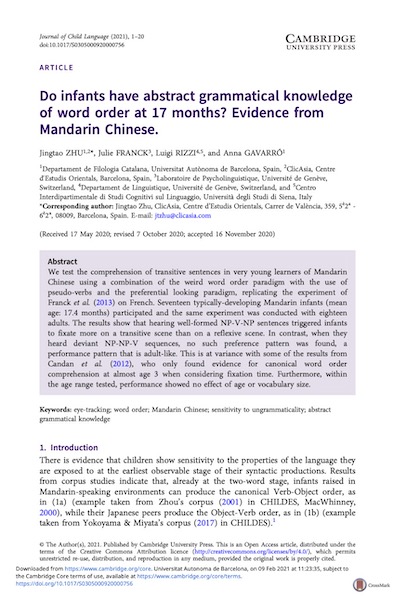
Do infants have abstract grammatical knowledge of word order at 17 months? Evidence from Mandarin ChineseEditorial: Journal of Child Language, Cambridge University Press
Data de publicació: Febrer del 2021
Més informació
Text completWe test the comprehension of transitive sentences in very young learners of Mandarin Chinese using a combination of the weird word order paradigm with the use of pseudo-verbs and the preferential looking paradigm, replicating the experiment of Franck et al. (2013) on French. Seventeen typically-developing Mandarin infants (mean age: 17.4 months) participated and the same experiment was conducted with eighteen adults. The results show that hearing well-formed NP-V-NP sentences triggered infants to fixate more on a transitive scene than on a reflexive scene. In contrast, when they heard deviant NP-NP-V sequences, no such preference pattern was found, a performance pattern that is adult-like. This is at variance with some of the results from Candan et al. (2012), who only found evidence for canonical word order comprehension at almost age 3 when considering fixation time. Furthermore, within the age range tested, performance showed no effect of age or vocabulary size.