20 juny, 2015
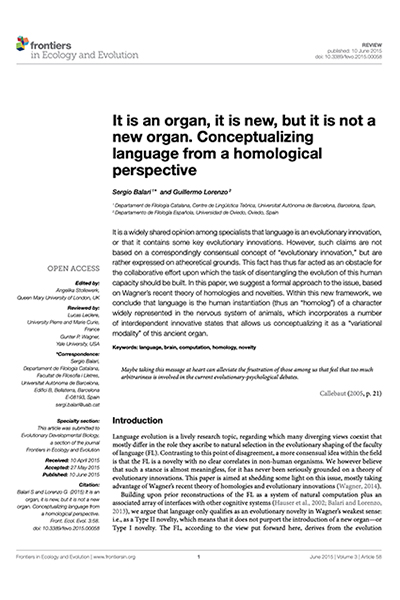
Autors:
Sergio Balari, Guillermo Lorenzo
Títol:
It is an organ, it is new, but it is not a new organ. Conceptualizing language from a homological perspectiveEditorial: Frontiers
Col·lecció: Frontiers in Ecology and Evolution #3Data de publicació: 2015
Pàgines: 18 Més informació
Text completIt is a widely shared opinion among specialists that language is an evolutionary innovation, or that it contains some key evolutionary innovations. However, such claims are not based on a correspondingly consensual concept of “evolutionary innovation,” but are rather expressed on atheoretical grounds. This fact has thus far acted as an obstacle for the collaborative effort upon which the task of disentangling the evolution of this human capacity should be built.
In this paper, we suggest a formal approach to the issue, based on Wagner's recent theory of homologies and novelties. Within this new framework, we conclude that language is the human instantiation (thus an “homolog”) of a character widely represented in the nervous system of animals, which incorporates a number of interdependent innovative states that allows us conceptualizing it as a “variational modality” of this ancient organ.
13 abril, 2021
Autors:
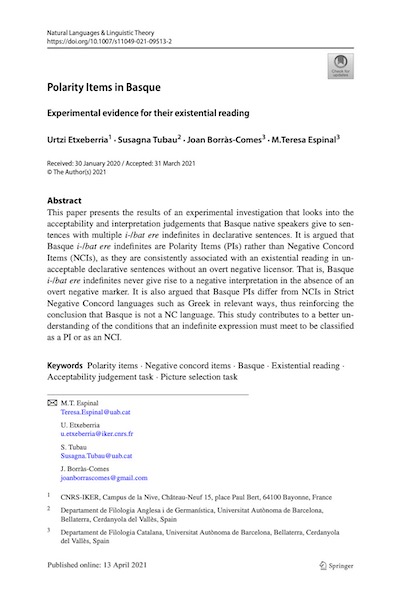
Urtzi Etxeberria, Susagna Tubau, Joan Borràs-Comes & M.Teresa Espinal
Títol:
Polarity Items in BasqueEditorial: Natural Language & Linguistic Theory, Springer
Data de publicació: 13 d'abril del 2021
This paper presents the results of an experimental investigation that looks into the acceptability and interpretation judgements that Basque native speakers give to sentences with multiple i-/bat ere indefinites in declarative sentences. It is argued that Basque i-/bat ere indefinites are Polarity Items (PIs) rather than Negative Concord Items (NCIs), as they are consistently associated with an existential reading in unacceptable declarative sentences without an overt negative licensor. That is, Basque i-/bat ere indefinites never give rise to a negative interpretation in the absence of an overt negative marker. It is also argued that Basque PIs differ from NCIs in Strict Negative Concord languages such as Greek in relevant ways, thus reinforcing the conclusion that Basque is not a NC language. This study contributes to a better understanding of the conditions that an indefinite expression must meet to be classified as a PI or as an NCI.
27 febrer, 2023
Autors:
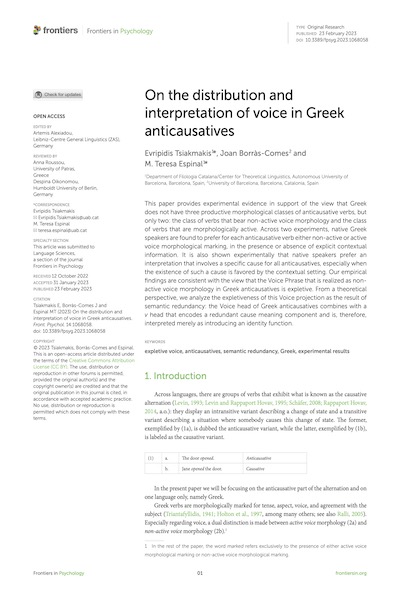
Evripidis Tsiakmakis, Joan Borràs-Comes i M.Teresa Espinal
Títol:
On the distribution and interpretation of voice in Greek anticausatives. Frontiers in PsychologyEditorial: Frontiers
Data de publicació: 23 de febrer del 2023
Pàgines: 15 Text completThis paper provides experimental evidence in support of the view that Greek does not have three productive morphological classes of anticausative verbs, but only two: the class of verbs that bear non-active voice morphology and the class of verbs that are morphologically active. Across two experiments, native Greek speakers are found to prefer for each anticausative verb either non-active or active voice morphological marking, in the presence or absence of explicit contextual information. It is also shown experimentally that native speakers prefer an interpretation that involves a specific cause for all anticausatives, especially when the existence of such a cause is favored by the contextual setting. Our empirical findings are consistent with the view that the Voice Phrase that is realized as non-active voice morphology in Greek anticausatives is expletive. From a theoretical perspective, we analyze the expletiveness of this Voice projection as the result of semantic redundancy: the Voice head of Greek anticausatives combines with a v head that encodes a redundant cause meaning component and is, therefore, interpreted merely as introducing an identity function.
31 desembre, 2022
Autors:
Io Salmons & Anna Gavarró
Títol:
Intervention effects in Catalan agrammatismEditorial: Glossa: a journal of general linguistics (Open Library of Humanities)
Data de publicació: 31 de desembre del 2022
Text completThe goal of the present study is to test the agrammatic comprehension of clitic left dislocation and contrastive focus in Catalan, in order to evaluate the Generalised Minimality hypothesis of Grillo (2009). According to this hypothesis, the comprehension deficit observed in agrammatism is the result of the underspecification of scope-discourse features giving rise to generalised intervention effects. We conducted two sentence-picture matching tasks to assess the comprehension of clitic left dislocation and contrastive focus with nine and seven Broca’s aphasic subjects, respectively, as well as control participants. The results show that the comprehension of SVO sentences and object clitics was preserved, whereas the comprehension of object dislocations and object focalisations was compromised. These findings are consistent with the analysis of the deficit as an instance of generalised intervention effects. Yet, we also examined the prediction that a relevant syntactic feature mismatch between the subject and the object would suffice to block generalised minimality effects; in particular, the number features of subject and object were controlled for. The agrammatic subjects’ performance on mismatched sentences did not differ from their performance on sentences where the subject and the object were matched in number. These findings call the hypothesis into question and stress the need for future research.
29 desembre, 2022
Autors:
Evripidis Tsiakmakis, Joan Borràs-Comes & M.Teresa Espinal
Títol:
Greek non-negative min, epistemic modality, and positive biasEditorial: Natural Language & Linguistic Theory (Springer)
Data de publicació: 29 de desembre del 2022
Text completModern Greek displays two variants of the word min; one corresponds to a negative marker, and the other corresponds to an epistemic modal. We focus on the latter and provide, for the first time to our knowledge, experimental evidence on its exact interpretation, showing that (i) non-negative min is incompatible with the overt realization of polar propositional alternatives {p,¬p}, (ii) it conveys medium speaker certainty with respect to the expressed proposition p, and (iii) it encodes speaker bias in favor of p. Our findings support the novel generalization that non-negative min is uniformly interpreted as conveying that the speaker is neither unbiased nor negatively biased (as suggested by the previous literature on the topic), but positively biased with respect to a proposition p. We argue that non-negative min is a biased epistemic modal that needs to be licensed by an external non-veridical operator.