12 setembre, 2019
Autors:
Joan Mascaró
Títol:
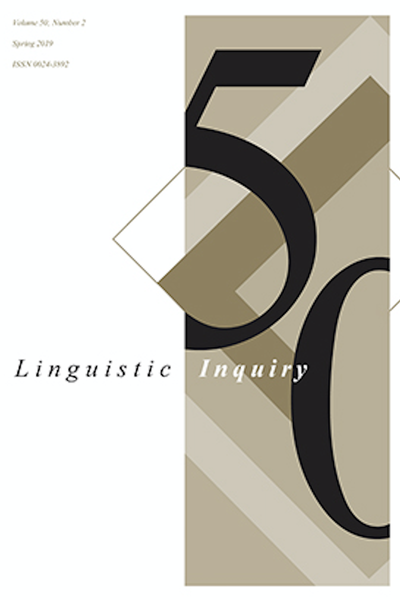
On the Lack of Evidence for Nonmyopic HarmonyEditorial: Linguistic Inquiry, vol.50(4). MIT Press
Data de publicació: Tardor de 2019
ISBN13: E-ISSN: 1530-9150
Més informació
One important property that has been attributed to unbounded spreading is myopia (spreading from T to U is independent of whether spreading can proceed into Z, where U is located between T and Z). Walker (Linguistic Inquiry 4.1, 2010) claims that metaphony in two Italo-Romance dialects, Grado and Central Veneto, does not obey myopia. My paper examines the evidence presented, as well as additional evidence. The evidence shows that in early 20th century Grado harmony is myopic, while in Central Veneto and the more recent variety of Grado there is no evidence in favor of non-myopic spreading. I conclude that the generalization that all attested unbounded spreading processes obey myopia still holds, and in particular that Romance metaphony is myopic. The paper concludes with a brief discussion of the problem of the quality of linguistic data.
3 setembre, 2019
Autors:
M.Teresa Espinal i Susagna Tubau
Títol:
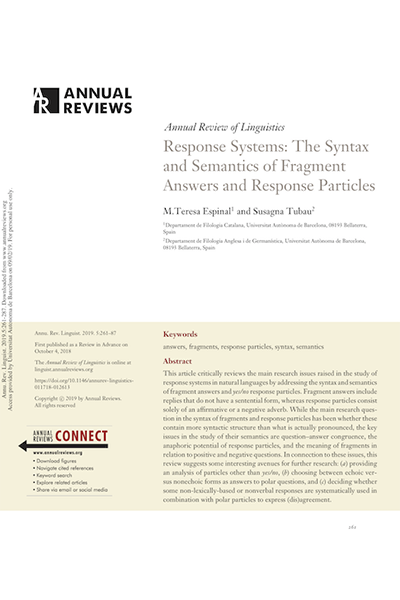
Response Systems: The Syntax and Semantics of Fragment Answers and Response ParticlesEditorial: Annual Review of Linguistics
Data de publicació: 20 de gener de 2019
Pàgines: 28 Més informació
Text complet
This article critically reviews the main research issues raised in the study of response systems in natural languages by addressing the syntax and semantics of fragment answers and yes/no response particles. Fragment answers include replies that do not have a sentential form, whereas response particles consist solely of an affirmative or a negative adverb. While the main research question in the syntax of fragments and response particles has been whether these contain more syntactic structure than what is actually pronounced, the key issues in the study of their semantics are question–answer congruence, the anaphoric potential of response particles, and the meaning of fragments in relation to positive and negative questions. In connection to these issues, this review suggests some interesting avenues for further research: (a) providing an analysis of particles other than yes/no, (b) choosing between echoic versus nonechoic forms as answers to polar questions, and (c) deciding whether some non-lexically-based or nonverbal responses are systematically used in combination with polar particles to express (dis)agreement.
20 juny, 2019
Autors:
Dària Serés, M.Teresa Espinal
Títol:
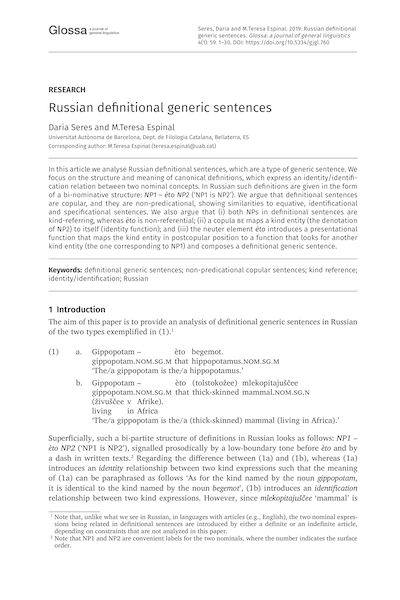
Russian definitional generic sentencesEditorial: Glossa: A Journal of General Linguistics, 4(1). Ubiquity Press
Data de publicació: 14 de juny de 2019
Pàgines: 30 Més informació
Text completIn this article we analyse Russian definitional sentences, which are a type of generic sentence. We focus on the structure and meaning of canonical definitions, which express an identity/identification relation between two nominal concepts. In Russian such definitions are given in the form of a bi-nominative structure: NP1 – èto NP2 (‘NP1 is NP2’). We argue that definitional sentences are copular, and they are non-predicational, showing similarities to equative, identificational and specificational sentences. We also argue that (i) both NPs in definitional sentences are kind-referring, whereas èto is non-referential; (ii) a copula be maps a kind entity (the denotation of NP2) to itself (identity function); and (iii) the neuter element èto introduces a presentational function that maps the kind entity in postcopular position to a function that looks for another kind entity (the one corresponding to NP1) and composes a definitional generic sentence.
14 setembre, 2019
Autors:
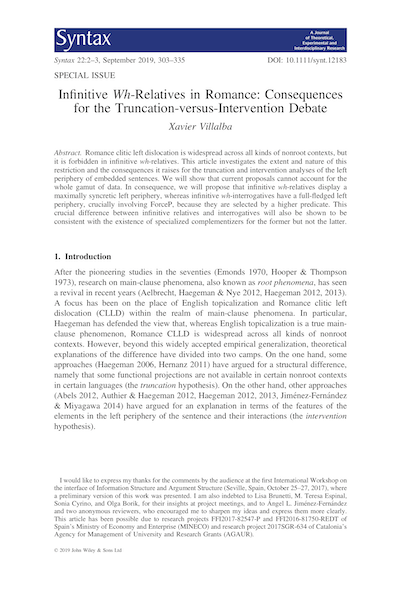
Xavier Villalba
Títol:
Infinitive Wh-Relatives in Romance: Consequences for the Truncation-versus-Intervention DebateEditorial: Syntax, vol.22:2–3 \\ Double Special Issue: Information Structure, Argument Structure, and Their Interfaces
Data de publicació: Agost de 2019
Més informació
Text completRomance clitic left dislocation is widespread across all kinds of nonroot contexts, but it is forbidden in infinitive wh-relatives. This article investigates the extent and nature of this restriction and the consequences it raises for the truncation and intervention analyses of the left periphery of embedded sentences. We will show that current proposals cannot account for the whole gamut of data. In consequence, we will propose that infinitive wh-relatives display a maximally syncretic left periphery, whereas infinitive wh-interrogatives have a full-fledged left periphery, crucially involving ForceP, because they are selected by a higher predicate. This crucial difference between infinitive relatives and interrogatives will also be shown to be consistent with the existence of specialized complementizers for the former but not the latter.
1 març, 2019
Autors:
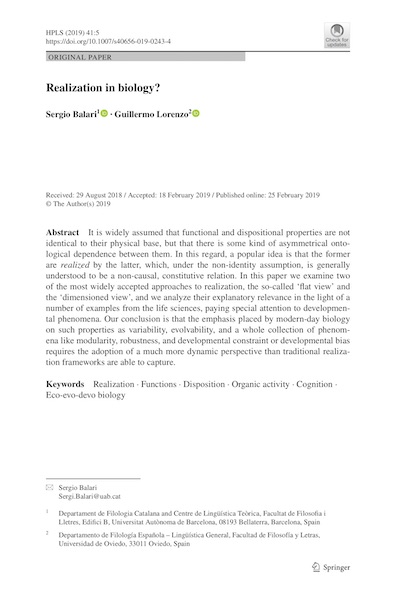
Sergio Balari, Guillermo Lorenzo
Títol:
Realization in biology?Editorial: Springer
Col·lecció: History and Philosophy of the Life Sciences #41:5Data de publicació: 2019
Pàgines: 27 Més informació
Text completIt is widely assumed that functional and dispositional properties are not identical to their physical base, but that there is some kind of asymmetrical ontological dependence between them. In this regard, a popular idea is that the former are realized by the latter, which, under the non-identity assumption, is generally understood to be a non-causal, constitutive relation. In this paper we examine two of the most widely accepted approaches to realization, the so-called ‘flat view’ and the ‘dimensioned view’, and we analyze their explanatory relevance in the light of a number of examples from the life sciences, paying special attention to developmental phenomena. Our conclusion is that the emphasis placed by modern-day biology on such properties as variability, evolvability, and a whole collection of phenomena like modularity, robustness, and developmental constraint or developmental bias requires the adoption of a much more dynamic perspective than traditional realization frameworks are able to capture.