26 gener, 2026
Autors:
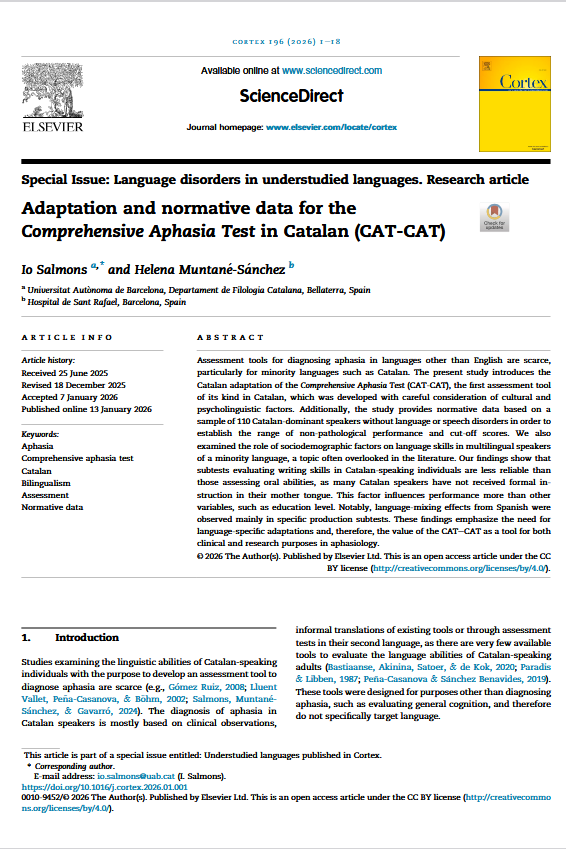
Io Salmons & Helena Muntané-Sánchez
Títol:
Adaptation and normative data for the Comprehensive Aphasia Test in Catalan (CAT-CAT)Editorial: Cortex
Data de publicació: 2026
ISBN13: 0010-9452
Text complet
Assessment tools for diagnosing aphasia in languages other than English are scarce, particularly for minority languages such as Catalan. The present study introduces the Catalan adaptation of the Comprehensive Aphasia Test (CAT-CAT), the first assessment tool of its kind in Catalan, which was developed with careful consideration of cultural and psycholinguistic factors. Additionally, the study provides normative data based on a sample of 110 Catalan-dominant speakers without language or speech disorders in order to establish the range of non-pathological performance and cut-off scores. We also examined the role of sociodemographic factors on language skills in multilingual speakers of a minority language, a topic often overlooked in the literature. Our findings show that subtests evaluating writing skills in Catalan-speaking individuals are less reliable than those assessing oral abilities, as many Catalan speakers have not received formal instruction in their mother tongue. This factor influences performance more than other variables, such as education level. Notably, language-mixing effects from Spanish were observed mainly in specific production subtests. These findings emphasize the need for language-specific adaptations and, therefore, the value of the CAT–CAT as a tool for both clinical and research purposes in aphasiology.
6 febrer, 2024
Autors:
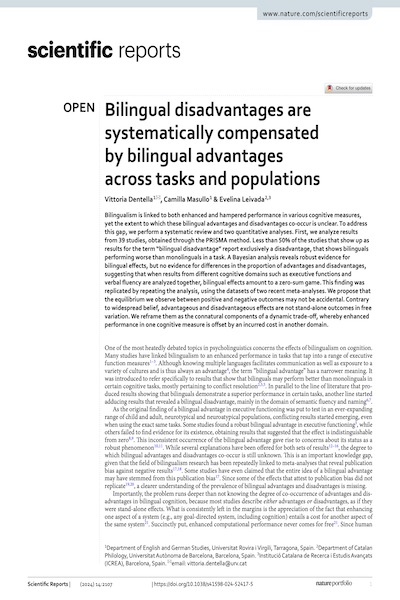
Vittoria Dentella, Camilla Masullo & Evelina Leivada
Títol:
Bilingual disadvantages are systematically compensated by bilingual advantages across tasks and populationsEditorial: Scientific Reports (Springer Nature)
Data de publicació: 24 de gener del 2024
Text completBilingualism is linked to both enhanced and hampered performance in various cognitive measures, yet the extent to which these bilingual advantages and disadvantages co-occur is unclear. To address this gap, we perform a systematic review and two quantitative analyses. First, we analyze results from 39 studies, obtained through the PRISMA method. Less than 50% of the studies that show up as results for the term “bilingual disadvantage” report exclusively a disadvantage, that shows bilinguals performing worse than monolinguals in a task. A Bayesian analysis reveals robust evidence for bilingual effects, but no evidence for differences in the proportion of advantages and disadvantages, suggesting that when results from different cognitive domains such as executive functions and verbal fluency are analyzed together, bilingual effects amount to a zero-sum game. This finding was replicated by repeating the analysis, using the datasets of two recent meta-analyses. We propose that the equilibrium we observe between positive and negative outcomes may not be accidental. Contrary to widespread belief, advantageous and disadvantageous effects are not stand-alone outcomes in free variation. We reframe them as the connatural components of a dynamic trade-off, whereby enhanced performance in one cognitive measure is offset by an incurred cost in another domain.
19 abril, 2024
Autors:
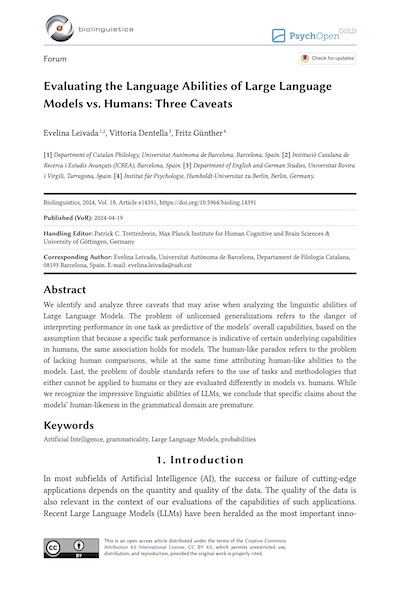
Evelina Leivada, Vittoria Dentella & Fritz Günther
Títol:
Biolinguistics, vol.18Editorial: PsychOpen
Data de publicació: 19 abril, 2024
Text completWe identify and analyze three caveats that may arise when analyzing the linguistic abilities of Large Language Models. The problem of unlicensed generalizations refers to the danger of interpreting performance in one task as predictive of the models’ overall capabilities, based on the assumption that because a specific task performance is indicative of certain underlying capabilities in humans, the same association holds for models. The human-like paradox refers to the problem of lacking human comparisons, while at the same time attributing human-like abilities to the models. Last, the problem of double standards refers to the use of tasks and methodologies that either cannot be applied to humans or they are evaluated differently in models vs. humans. While we recognize the impressive linguistic abilities of LLMs, we conclude that specific claims about the models’ human-likeness in the grammatical domain are premature.
3 abril, 2025

Autors:
Masullo, Casado, Leivada & Sorace
Títol:
Register variation and linguistic background modulate accuracy in detecting morphosyntactic errorsEditorial: Isogloss. Open Journal of Romance Linguistics
Data de publicació: 30-03-2025
Pàgines: 36 Més informació
Text completLinguistic register is defined as a variety of language shaped by different situational settings. Adapting to register is crucial for successful communication and involves the processing of language features related to register variation. Few studies have focused on the impact of linguistic register on language processing. Our research investigates whether register variation affects the detection of linguistic errors. To determine if linguistic background further impacts the way we deal with register, our sample includes monolingual, bilingual, and bidialectal participants. All groups completed an acceptability judgement task in Italian that features Subject-Verb agreement mismatches presented in high and low register. The results reveal a significant impact of linguistic register on accuracy: morphosyntactic errors are better detected in low-register stimuli. Furthermore, different trends characterize the tested groups. While monolinguals show more similar accuracy rates for low- and high-register sentences, the bilingual groups tend to better spot errors in low-register stimuli. Our findings suggest that register plays an important role in the processing of morphosyntactic errors, highlighting the need to consider both its cognitive and social dimensions. Moreover, the variation observed among the tested groups underscores that language processing can be influenced by factors related to the sociolinguistic dimensions of each linguistic community.
18 juliol, 2025
Autors:
Leivada, Marcus, Günther & Murphy
Títol:
A Sentence is Worth a Thousand Pictures: Can Large Language Models Understand Hum4n L4ngu4ge and the W0rld behind W0rds?Editorial: Philosophical Transactions of the Royal Society A
Data de publicació: 2025
Pàgines: 19 Més informació
Text completModern Artificial Intelligence applications show great potential for language- related tasks that rely on next-word prediction. The current generation of Large Language Models (LLMs) have been linked to claims about human-like linguistic performance and their applications are hailed both as a step towards artificial general intelligence and as a major advance in understanding the cognitive, and even neural basis of human language. To assess these claims, first we analyze the contribution of LLMs as theoretically informative representations of a target cognitive system vs. atheoretical mechanistic tools. Second, we evaluate the models’ ability to see the bigger picture, through top-down feedback from higher levels of processing, which requires grounding in previous expectations and past world experience. We hypothesize that since models lack grounded cognition, they cannot take advantage of these features and instead solely rely on fixed associations between represented words and word vectors. To assess this, we designed and ran a novel ‘leet task’ (l33t t4sk), which requires decoding sentences in which letters are systematically replaced by numbers. The results suggest that humans excel in this task whereas models struggle, confirming our hypothesis. We interpret the results by identifying the key abilities that are still missing from the current state of development of these models, which require solutions that go beyond increased system scaling.