18 desembre, 2023
Autors:
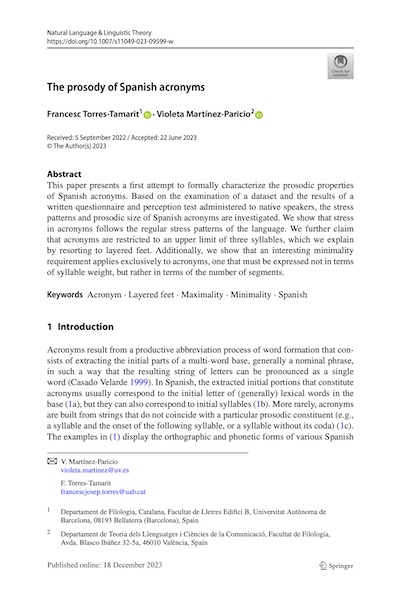
Francesc Torres-Tamarit & Violeta Martínez-Paricio
Títol:
The prosody of Spanish acronymsEditorial: Natural Language & Linguistic Theory (Springer)
Data de publicació: 18 desembre 2023
Text completThis paper presents a first attempt to formally characterize the prosodic properties of Spanish acronyms. Based on the examination of a dataset and the results of a written questionnaire and perception test administered to native speakers, the stress patterns and prosodic size of Spanish acronyms are investigated. We show that stress in acronyms follows the regular stress patterns of the language. We further claim that acronyms are restricted to an upper limit of three syllables, which we explain by resorting to layered feet. Additionally, we show that an interesting minimality requirement applies exclusively to acronyms, one that must be expressed not in terms of syllable weight, but rather in terms of the number of segments.
3 juny, 2024
Autors:
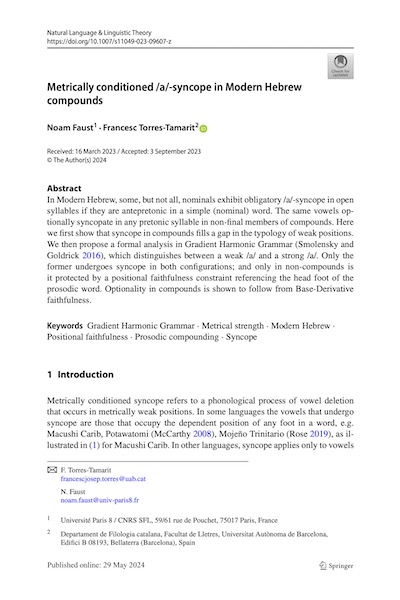
Noam Faust & Francesc Torres-Tamarit
Títol:
Metrically conditioned /a/-syncope in Modern Hebrew compoundsEditorial: Natural Language & Linguistic Theory (Springer Link)
Data de publicació: 29 maig 2024
Text completIn Modern Hebrew, some, but not all, nominals exhibit obligatory /a/-syncope in open syllables if they are antepretonic in a simple (nominal) word. The same vowels optionally syncopate in any pretonic syllable in non-final members of compounds. Here we first show that syncope in compounds fills a gap in the typology of weak positions. We then propose a formal analysis in Gradient Harmonic Grammar (Smolensky and Goldrick 2016), which distinguishes between a weak /a/ and a strong /a/. Only the former undergoes syncope in both configurations; and only in non-compounds is it protected by a positional faithfulness constraint referencing the head foot of the prosodic word. Optionality in compounds is shown to follow from Base-Derivative faithfulness.
26 novembre, 2024

Autors:
Francesc Torres-Tamarit
Títol:
Proceedings of the 39th West Coast Conference on Formal LinguisticsEditorial: Cascadilla Proceedings Project, Somerville, MA, USA
Data de publicació: 2024
Més informació
Text completAccording to Loporcaro's (2015) book on Romance length, contrastive vowel length in northern Italo-Romance is metrically-governed and implicationally distributed. CVL in proparoxytones implies CVL in paroxytones, but not the other way around. Likewise, CVL in paroxytones implies CVL in oxytones, but not vice versa. This paper develops a foot-based OT analysis of CVL in northern Italo-Romance that combines layered feet (Martínez-Paricio & Kager 2015) with uneven trochees (Jacobs 2019). The analysis adequately predicts the implicational distribution of CVL and discards unattested patterns.
11 juliol, 2025
Autors:
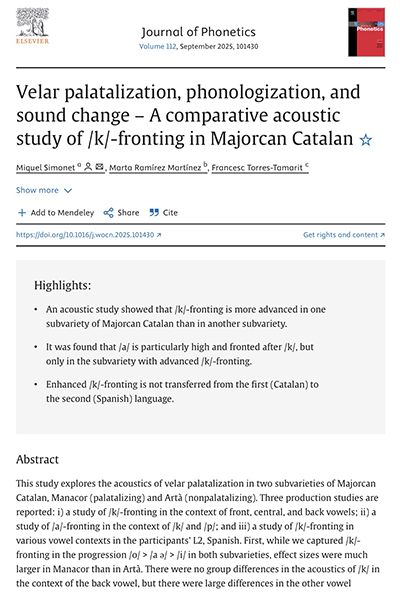
Simonet, Ramírez Martínez & Torres-Tamarit
Títol:
Velar palatalization, phonologization, and sound change – A comparative acoustic study of /k/-fronting in Majorcan CatalanEditorial: Journal of Phonetics
Data de publicació: 2025
Més informacióThis study explores the acoustics of velar palatalization in two subvarieties of Majorcan Catalan, Manacor (palatalizing) and Artà (nonpalatalizing). Three production studies are reported: i) a study of /k/-fronting in the context of front, central, and back vowels; ii) a study of /a/-fronting in the context of /k/ and /p/; and iii) a study of /k/-fronting in various vowel contexts in the participants’ L2, Spanish. First, while we captured /k/-fronting in the progression /o/ > /a ə/ > /i/ in both subvarieties, effect sizes were much larger in Manacor than in Artà. There were no group differences in the acoustics of /k/ in the context of the back vowel, but there were large differences in the other vowel contexts, particularly before the central vowels. We postulate that, whereas the degree of palatalization found in Artà may result from universal coarticulatory principles, palatalization in Manacor results from speaker-controlled phonetic behavior: enhanced coarticulation. Second, we found that in Manacor (but not Artà) /a/ was more fronted when it followed /k/ that when it followed /p/. We suggest that the /a/-fronting pattern found in Manacor results from the influence of its velar-palatalization process and not vice versa. Finally, we found that the enhanced velar-palatalization process in the Manacor sample was not transferred to their L2. We discuss the implications of our conclusion for our understanding of the diachrony of velar palatalization in Romance.
2 març, 2026
Autors:
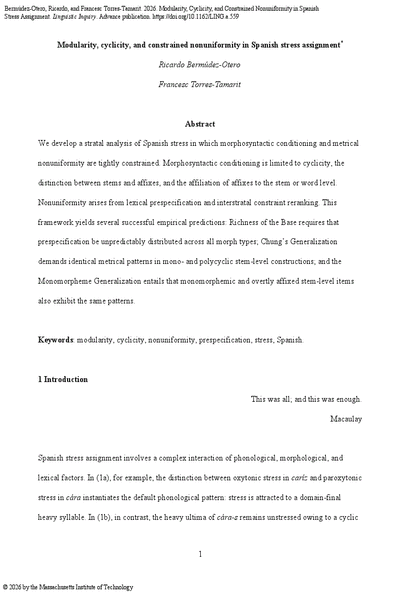
Bermúdez-Otero, Ricardo, and Francesc Torres-Tamarit
Títol:
Modularity, Cyclicity, and Constrained Nonuniformity in Spanish Stress AssignmentEditorial: Linguistic Inquiry
Data de publicació: 2026
Més informació
Text complet
Abstract
We develop a stratal analysis of Spanish stress in which morphosyntactic conditioning and metrical nonuniformity are tightly constrained. Morphosyntactic conditioning is limited to cyclicity, the distinction between stems and affixes, and the affiliation of affixes to the stem or word level. Nonuniformity arises from lexical prespecification and interstratal constraint reranking. This framework yields several successful empirical predictions: Richness of the Base requires that prespecification be unpredictably distributed across all morph types; Chung’s Generalization demands identical metrical patterns in mono- and polycyclic stem-level constructions; and the Monomorpheme Generalization entails that monomorphemic and overtly affixed stem-level items also exhibit the same patterns.