13 abril, 2026
Autors:
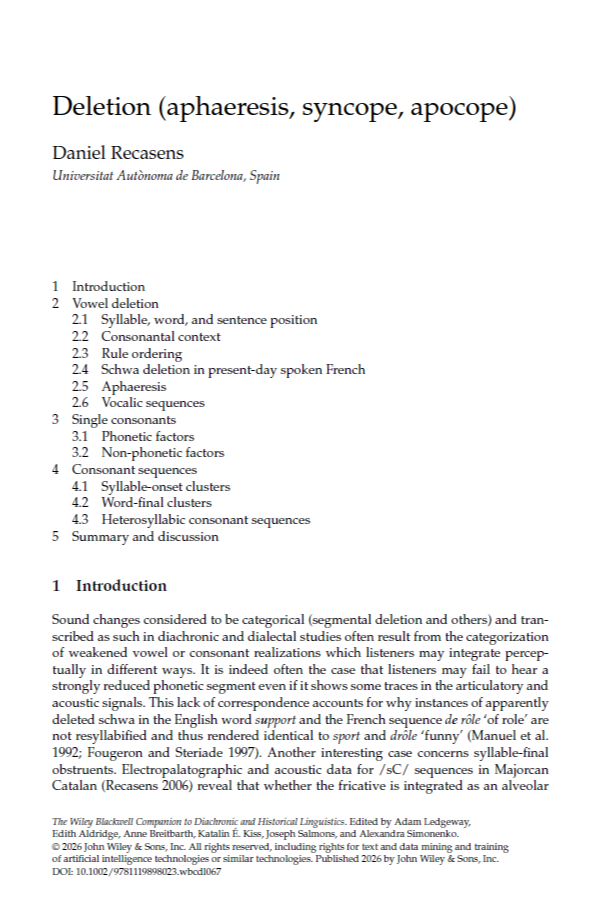
Recasens, Daniel
Títol:
Deletion (aphaeresis, syncope, apocope)Editorial: The Wiley Blackwell Companion to Diachronic and Historical Linguistics
Col·lecció: The Wiley Blackwell Companion to Diachronic and Historical LinguisticsData de publicació: 2026
Més informació Edited by Adam Ledgeway, Edith Aldridge, Anne Breitbarth, Katalin É. Kiss, Joseph Salmons, and Alexandra Simonenko, John Wiley & Sons, Inc.
15 maig, 1981
Autors:
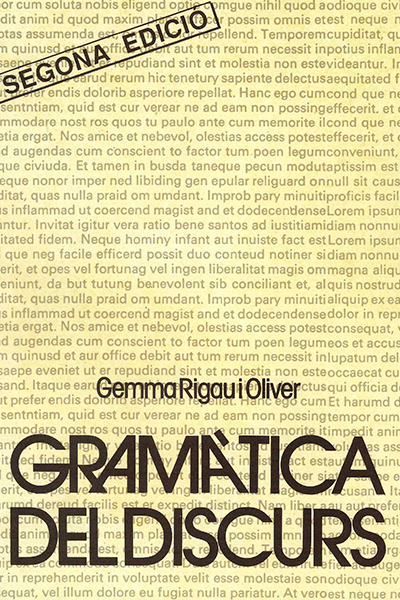
Gemma Rigau
Títol:
Gramàtica del discursEditorial: Universitat Autònoma de Barcelona, Servei de Publicacions
Col·lecció: Sèrie Lingüística #1Data de publicació: 1981
Pàgines: 539 Text completLa lingüística generativa aspira a confegir gramàtiques que donin compte adequadament de la competència lingüística dels parlants, o més exactament, gramàtiques que esdevinguin un model del coneixement que de la pròpia llengua tenen els parlants. Ara bé, aquesta competència lingüística no es pot entendre com a referida únicament i exclusivament a la producció i a la comprensió de frases, ja que tot parlant està igualment capacitat per a produir i entendre infinits discursos o textos coherents de la seva llengua. L'objectiu central del present llibre és justament prendre acte d'aquest fet. S'hi ha volgut mostrar la conveniència i fins la necessitat d'elaborar gramàtiques (per a la descripció i explicació de les llengües naturals, i específicament en el cas del català) que ultrapassin els límits oracionals i centrin la seva atenció en el discurs.
Títols de la col·lecció / Also in this series:
19 febrer, 2017
Autors:
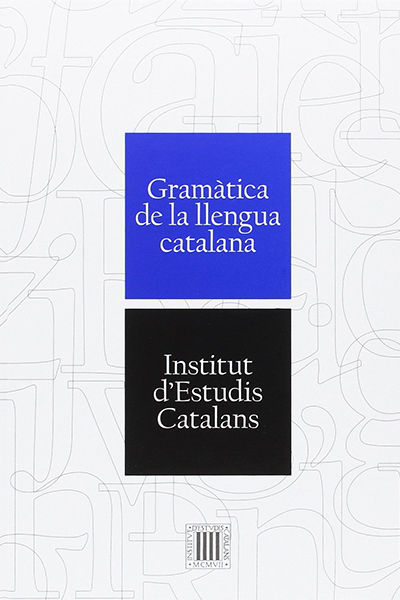
Manuel Pérez Saldanya (Dir.), Gemma Rigau i Oliver (Dir.)
Títol:
Gramàtica de la llengua catalanaEditorial: Institut d'Estudis Catalans
Data de publicació: 2016
Pàgines: 1439ISBN13: 978-84-9965-316-7
Més informacióLa Gramàtica de la llengua catalana és la gramàtica oficial de l’Institut d’Estudis Catalans (IEC). Ha estat pensada com la gramàtica normativa de referència del segle XXI. A diferència de la de Pompeu Fabra, que era una gramàtica d’autor, la de l’IEC és una obra col·lectiva, oberta a la participació d’experts diversos i consensuada en el si de la Comissió de Gramàtica i la Secció Filològica, i ratificada pel Ple de l’IEC. La Gramàtica de la llengua catalana dóna continuïtat a la normativa gramatical que Pompeu Fabra va establir l’any 1918, i es presenta més completa i actualitzada.
No introdueix, doncs, canvis substancials, sinó matisos i més flexibilitat, i amplia i detalla la gramàtica de Fabra per donar resposta a qüestions que aquest no va plantejar o que va apuntar molt esquemàticament. Al mateix temps, incorpora les solucions avalades per la tradició i el prestigi social que encara no tenien el reconeixement per part de la norma. L’obra es caracteritza perquè presenta la norma partint de la descripció gramatical i atenent al marc geogràfic (els parlars) i social (és a dir, els diferents registres), així com, més esporàdicament, a la dimensió oral i escrita.
També presenta en primer terme i d’una manera neutra els fets generals que són vàlids en tots els territoris del domini lingüístic català i en tots els registres, i concreta en quins parlars i registres són vàlids els restants, i si una determinada forma és o no és acceptable.