17 setembre, 2020
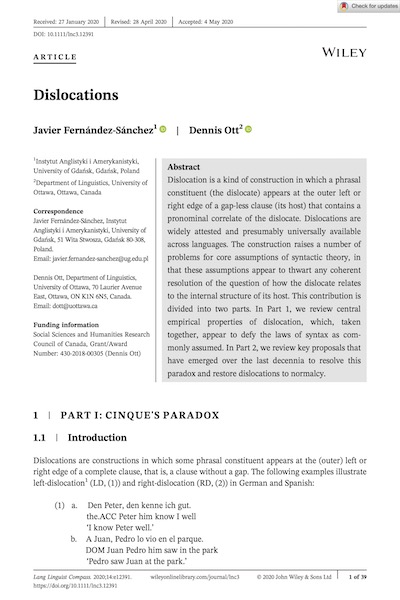
Autors:
Javier Fernández Sánchez & Dennis Ott
Títol:
DislocationsEditorial: Language and Linguistics Compass, Vol.14 issue 9 (John Wiley & Sons Ltd)
Data de publicació: Setembre 2020
Text completDislocation is a kind of construction in which a phrasal constituent (the dislocate) appears at the outer left or right edge of a gap-less clause (its host) that contains a pronominal correlate of the dislocate. Dislocations are widely attested and presumably universally available across languages. The construction raises a number of problems for core assumptions of syntactic theory, in that these assumptions appear to thwart any coherent resolution of the question of how the dislocate relates to the internal structure of its host. This contribution is divided into two parts. In Part 1, we review central empirical properties of dislocation, which, taken together, appear to defy the laws of syntax as commonly assumed. In Part 2, we review key proposals that have emerged over the last decennia to resolve this paradox and restore dislocations to normalcy.
16 maig, 2025
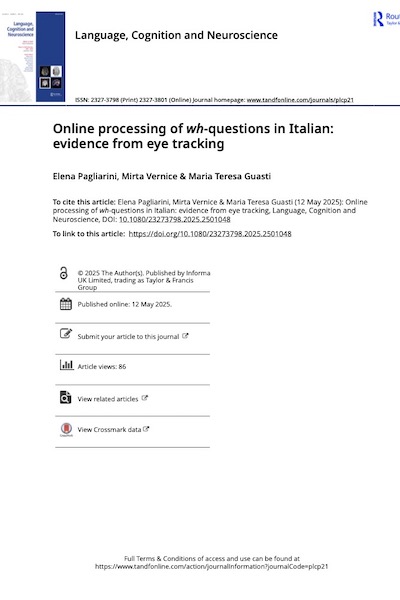
Autors:
Pagliarini, Vernice, & Guasti
Títol:
Online processing of wh-questions in Italian: evidence from eye trackingEditorial: Language, Cognition and Neuroscience
Data de publicació: 12-05-2025
Pàgines: 14 Més informació
Text completThis study investigates the processing of subject and object direct questions headed by wh-elements such as chi (i.e. who) and quale-NP (i.e. which-NP) in Italian, a pro-drop language that allows post-verbal subjects. In Italian, chi and quale-NP questions are ambiguous: they can be interpreted as either subject or object, in the absence of morphological or pragmatic disambiguation. Using eye tracking techniques, we explore how different types of wh-elements (chi vs. quale-NP) and extraction sites (subject vs. object) are processed when disambiguated by number verbal agreement. A distinct processing pattern emerges between chi and quale-NP questions: while quale-NP questions generally demand more cognitive effort when encountering the verb, chi questions necessitate increased processing during post-verbal NP integration. Additionally, a wh-subject extraction preference is observed, which reflects an active gap filling strategy across types of wh-elements. These findings are discussed in terms of the processing mechanisms underlying the elaboration of wh-questions.
1 gener, 2022
Autors:
Pagliarini, E., Lungu, O., van Hout, A., Pinter, L., Balázs, S., Crain, S. & Guasti, M.T.
Títol:
How children interpret disjunction under negation in Dutch, French, Hungarian and Italian: a cross-linguistic comparison. Language, Learning and DevelopmentEditorial: Language Learning and Development
Data de publicació: 2022
Text complet
28 gener, 2025
Autors:
Guasti, M. T. & Pagliarini, E.
Títol:
Universal and language-specific properties of language: a view from language acquisitionEditorial: Sjef Barbiers, Norbert Corver & Maria Polinksy (eds.) Handbook of Comparative Syntax, Cambridge: Cambridge University Press
Data de publicació: 2025
28 gener, 2018
Autors:
Pagliarini, E., Bill, C., Tieu, L., Romoli, J. & Crain, S.
Títol:
On children’s variable success with scalar implicatures: Insights from disjunction in the scope of a universal quantifier.Editorial: Cognition
Data de publicació: 2018
Text complet