15 agost, 2022
Autors:
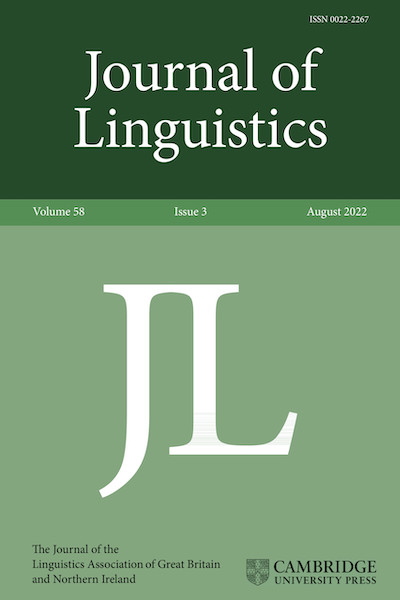
M.T. Espinal & Sonia Cyrino
Títol:
A syntactically-driven approach to indefiniteness, specificity and anti-specificityEditorial: Journal of Linguistics 58(3), Cambridge University Press
Data de publicació: Agost 2022
Més informacióIn this paper we present an original approach to analyze the compositionality of indefinite expressions in Romance by investigating the relevance of their syntactic distribution in relation to their meaning. This approach has the advantage of allowing us to explore the question of how syntactic structure can determine the meaning of different forms of indefiniteness. To that end, we postulate a common derivation for bare plurals, bare mass and de phrases, whereby an abstract operator DE is adjoined to definite determiners and shifts entities into property-type expressions. Quantificational specificity is proposed to be derived from a syntactic structure in which weak quantifiers select for indefinite DE-phrases, no matter whether de is overt at Spell-Out or not; these quantifiers turn properties into generalized quantifiers. The anti-specificity meaning of some indefinites is derived by adjoining in the syntactic structure an abstract operator ALG that encodes the speaker’s epistemic state of ignorance to a quantifier encoded for specificity, and it turns a generalized quantifier into a modified generalized quantifier. The paper also brings some general predictions on how indefiniteness is expressed in Romance, as it provides extensive support from five Romance languages: Brazilian Portuguese, Catalan, French, Italian and Spanish.
8 juny, 2022
Autors:
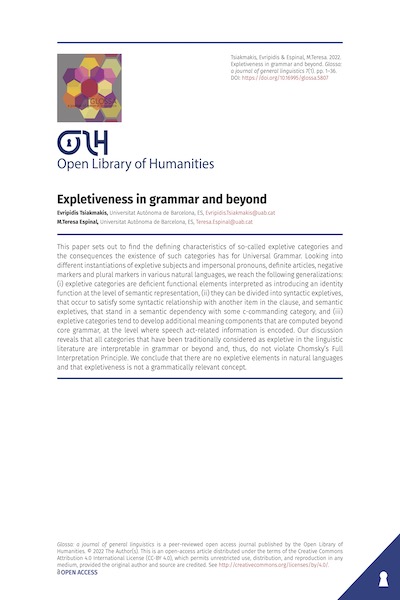
Tsiakmakis, E. & M.T. Espinal
Títol:
Expletiveness in grammar and beyondEditorial: Glossa: a journal of general linguistics, 7(1)
Data de publicació: Maig del 2022
Text completThis paper sets out to find the defining characteristics of so-called expletive categories and the consequences the existence of such categories has for Universal Grammar. Looking into different instantiations of expletive subjects and impersonal pronouns, definite articles, negative markers and plural markers in various natural languages, we reach the following generalizations: (i) expletive categories are deficient functional elements interpreted as introducing an identity function at the level of semantic representation, (ii) they can be divided into syntactic expletives, that occur to satisfy some syntactic relationship with another item in the clause, and semantic expletives, that stand in a semantic dependency with some c-commanding category, and (iii) expletive categories tend to develop additional meaning components that are computed beyond core grammar, at the level where speech act-related information is encoded. Our discussion reveals that all categories that have been traditionally considered as expletive in the linguistic literature are interpretable in grammar or beyond and, thus, do not violate Chomsky’s Full Interpretation Principle. We conclude that there are no expletive elements in natural languages and that expletiveness is not a grammatically relevant concept.
14 juliol, 2021
Autors:
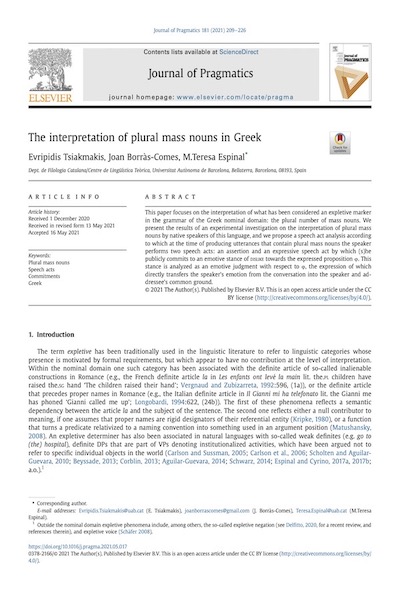
Evripidis Tsiakmakis, Joan Borràs-Comes, M.Teresa Espinal
Títol:
The interpretation of plural mass nouns in Greek, Journal of Pragmatics 181Editorial: Elsevier
Data de publicació: Agost 2021
Més informacióThis paper focuses on the interpretation of what has been considered an expletive marker in the grammar of the Greek nominal domain: the plural number of mass nouns. We present the results of an experimental investigation on the interpretation of plural mass nouns by native speakers of this language, and we propose a speech act analysis according to which at the time of producing utterances that contain plural mass nouns the speaker performs two speech acts: an assertion and an expressive speech act by which (s)he publicly commits to an emotive stance of dislike towards the expressed proposition φ. This stance is analyzed as an emotive judgment with respect to φ, the expression of which directly transfers the speaker's emotion from the conversation into the speaker and addressee's common ground.
13 abril, 2021
Autors:
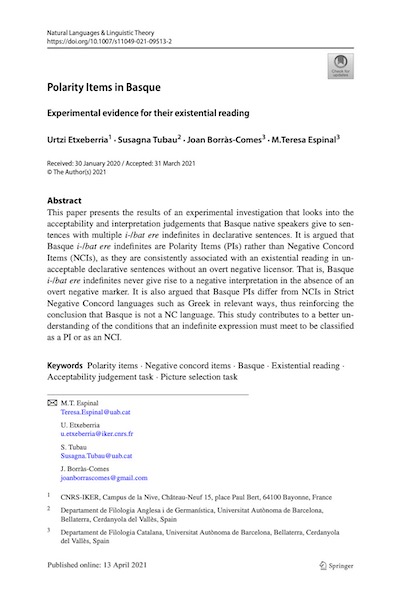
Urtzi Etxeberria, Susagna Tubau, Joan Borràs-Comes & M.Teresa Espinal
Títol:
Polarity Items in BasqueEditorial: Natural Language & Linguistic Theory, Springer
Data de publicació: 13 d'abril del 2021
This paper presents the results of an experimental investigation that looks into the acceptability and interpretation judgements that Basque native speakers give to sentences with multiple i-/bat ere indefinites in declarative sentences. It is argued that Basque i-/bat ere indefinites are Polarity Items (PIs) rather than Negative Concord Items (NCIs), as they are consistently associated with an existential reading in unacceptable declarative sentences without an overt negative licensor. That is, Basque i-/bat ere indefinites never give rise to a negative interpretation in the absence of an overt negative marker. It is also argued that Basque PIs differ from NCIs in Strict Negative Concord languages such as Greek in relevant ways, thus reinforcing the conclusion that Basque is not a NC language. This study contributes to a better understanding of the conditions that an indefinite expression must meet to be classified as a PI or as an NCI.
27 octubre, 2020
Autors:
S. Tubau, U. Etxeberria, V. Déprez i M.T. Espinal (coeditors)
Títol:
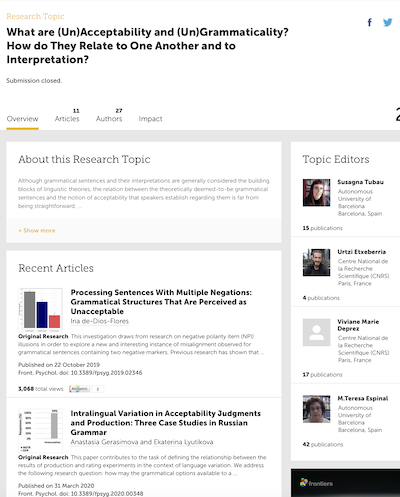
Research topic: What are (un)acceptabiity and (un)grammaticality? How do they relate to one another and to interpretation? Frontiers in PsychologyEditorial: Frontiers
Data de publicació: 2020
Més informacióAlthough grammatical sentences and their interpretations are generally considered the building blocks of linguistic theories, the relation between the theoretically deemed-to-be grammatical sentences and the notion of acceptability that speakers establish regarding them is far from being straightforward.
Some grammatical sentences that present parsing complications (e.g. garden-path sentences) might appear unacceptable to speakers, as they are difficult to understand. Other sentences, considered as ungrammatical by theoreticians (e.g. wh-island violations, sentences with resumptive pronouns, semantically implausible sequences, and sentences with unlicensed negative polarity items) might be perceived as acceptable by speakers and lead to reliable interpretations.
To further complicate matters, recent research on how grammatical 'illusions' (e.g. negative polarity item licensing, and comparative illusions) are perceived, understood and processed has revealed that speakers can subconsciously correct ungrammatical or ill-formed sentences by making use of specific repair strategies. Studies have also revealed that adults can learn to understand novel constructions considered to be syntactically ungrammatical (e.g. the ‘needs’ construction).
Taking into account these experimental results, there is now a fundamental need for novel operational, empirically and theoretically grounded redefinitions for core notions such as:
(un)acceptability; (un)grammaticality and, finally, the continual exploration of the existing complex interactions between sentences’ (un)acceptability and (un)grammaticality and their final interpretation.
In this vein, it seems necessary to evaluate how suitable specialized research methods can be, to establish the degree and extent to which particular linguistic structures and their interpretations are acceptable or unacceptable to speakers and how this can reliably relate to theoretical (un)grammaticality. If necessary, more analytic methodologies (e.g. acceptability scales, elicitation techniques, time forced-choice tasks, etc.) must be developed in order to provide dependable results informing on linguistic theory. This should lead to (i) a better understanding of what makes (un)grammatical sentences (un)acceptable or the other way around, (ii) a better account of speaker’s preferences and optionality in connection to (un)acceptability and (un)grammaticality, and (iii) the role of performance factors, memory limitations, and processing mechanisms in the evaluation of (un)acceptability, (un)grammaticality, and interpretation of linguistic structures.
We welcome manuscripts addressing any of the following topics and subtopics from theoretical and/or experimental perspectives, covering a wide range of languages and linguistic structures:
-What is (un)acceptability in linguistics?
-How does (un)acceptability relate to (un)grammaticality?
-Methodological issues related to (un)acceptability and/or (un)grammaticality.
-How are speaker's preferences and optionality connected to (un)acceptability and (un)grammaticality?
-What factors are relevant for the evaluation of (un)acceptability, (un)grammaticality, and interpretation of linguistic structures?