Etxeberria, Espinal & Tubau (2024). Establishing the limits between Polarity Sensitivity, Negative Polarity and Negative Concord
Autors:
Urtzi Etxeberria, M.Teresa Espinal & Susagna TubauTítol:
Establishing the limits between Polarity Sensitivity, Negative Polarity and Negative ConcordEditorial: Linguistic Typology (de Gruyter)
Data de publicació: 4 d'abril del 2024
Text complet
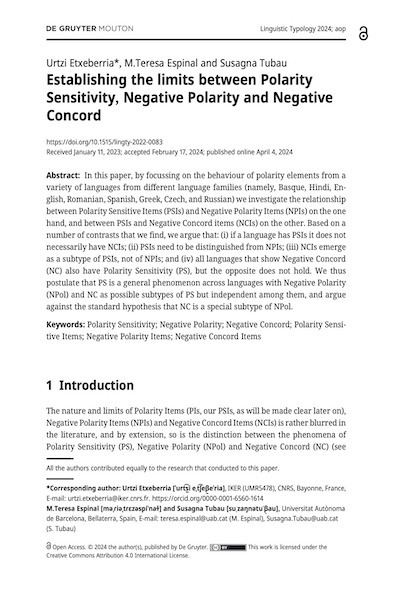
In this paper, by focussing on the behaviour of polarity elements from a variety of languages from different language families (namely, Basque, Hindi, English, Romanian, Spanish, Greek, Czech, and Russian) we investigate the relationship between Polarity Sensitive Items (PSIs) and Negative Polarity Items (NPIs) on the one hand, and between PSIs and Negative Concord items (NCIs) on the other. Based on a number of contrasts that we find, we argue that: (i) if a language has PSIs it does not necessarily have NCIs; (ii) PSIs need to be distinguished from NPIs; (iii) NCIs emerge as a subtype of PSIs, not of NPIs; and (iv) all languages that show Negative Concord (NC) also have Polarity Sensitivity (PS), but the opposite does not hold. We thus postulate that PS is a general phenomenon across languages with Negative Polarity (NPol) and NC as possible subtypes of PS but independent among them, and argue against the standard hypothesis that NC is a special subtype of NPol.