3 octubre, 2024
Autors:
Gemma Repiso-Puigdelliura
Títol:
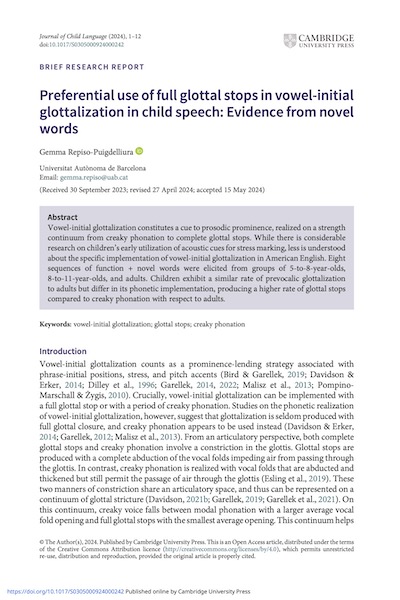
Preferential use of full glottal stops in vowel-initial glottalization in child speech: Evidence from novel wordsEditorial: Journal of Child Language (Cambridge University Press)
Data de publicació: 3 d'octubre 2024
Text completVowel-initial glottalization constitutes a cue to prosodic prominence, realized on a strength continuum from creaky phonation to complete glottal stops. While there is considerable research on children’s early utilization of acoustic cues for stress marking, less is understood about the specific implementation of vowel-initial glottalization in American English. Eight sequences of function + novel words were elicited from groups of 5-to-8-year-olds, 8-to-11-year-olds, and adults. Children exhibit a similar rate of prevocalic glottalization to adults but differ in its phonetic implementation, producing a higher rate of glottal stops compared to creaky phonation with respect to adults.
27 febrer, 2025

Autors:
Gemma Repiso-Puigdelliura
Títol:
Development of Vowel Intrusion in Spanish Heritage SpeakersEditorial: Language and Speech
Data de publicació: 27-02-2025
Més informacióThis study investigates the sound system of heritage speakers (henceforth, HSs) as they shift dominance from their heritage language to their majority language. Specifically, it analyzes the production of intrusive vowels in Spanish consonant clusters across the lifespan of HSs, focusing on tautosyllabic clusters (i.e., /Cɾ/) and heterosyllabic clusters (i.e., /ɾ.C/). Semi-spontaneous speech was elicited from three age groups of Spanish HSs—younger children, older children, and adults—for whom American English is the majority language, as well as from three age-matched groups of non-heritage Spanish speakers raised in Mexico. The presence and duration of intrusive vowels were examined, with the latter calculated as a ratio of intrusive vowel duration to tap duration. Overall, the results indicate that all speaker groups more frequently produce consonant clusters with intrusive vowels than without. However, Spanish HSs produced fewer and shorter intrusive vowels compared with their non-heritage counterparts. In addition, heritage and non-heritage speakers exhibited a lower rate of intrusive vowel production in the 5-to-8 -year-old group compared with adults. Despite this, the absence of an interaction between age group and speaker type suggests a parallel pattern of change in intrusive vowel production across all ages. Voicing emerged as the most consistent phonetic factor, predicting a higher rate of intrusive vowels with a longer duration relative to the tap.
29 setembre, 2025
Autors:
Gemma Repiso-Puigdelliura
Títol:
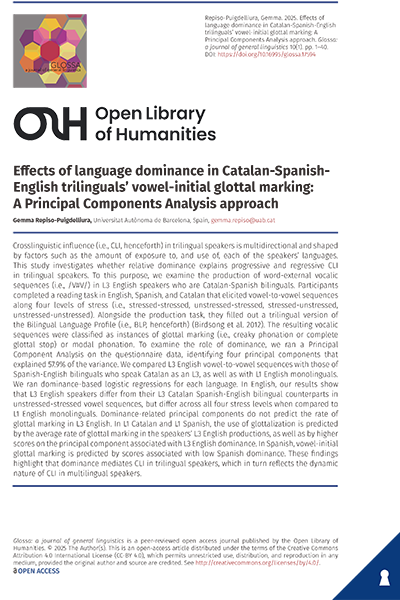
Effects of language dominance in Catalan-Spanish-English trilinguals' vowel-initial glottal marking: A Principal Components Analysis approachEditorial: Glossa: a journal of general linguistics
Data de publicació: 8 de setembres de 2025
Més informacióCrosslinguistic influence (i.e., CLI, henceforth) in trilingual speakers is multidirectional and shaped by factors such as the amount of exposure to, and use of, each of the speaker’s languages. This study investigates whether relative dominance explains progressive and regressive CLI in trilingual speakers. To this purpose, we examine the production of word-external vocalic sequences (i.e., /V#V/) in L3 English speakers who are Catalan-Spanish bilinguals. Participants completed a reading task in English, Spanish, and Catalan that elicited vowel-to-vowel sequences along four levels of stress (i.e., stressed-stressed, unstressed-stressed, stressed-unstressed, unstressed-unstressed). Alongside the production task, they filled out a trilingual version of the Bilingual Language Profile (i.e., BLP, henceforth) (Birdsong et al. 2012). The resulting vocalic sequences were classified as instances of glottal marking (i.e., creaky phonation or complete glottal stop) or modal phonation. To examine the role of dominance, we ran a Principal Component Analysis on the questionnaire data, identifying four principal components that explained 57.9% of the variance. We compared L3 English vowel-to-vowel sequences with those of Spanish-English bilinguals who speak Catalan as an L3, as well as with L1 English monolinguals. We ran dominance-based logistic regressions for each language. In English, our results show that L3 English speakers differ from their L3 Catalan Spanish-English bilingual counterparts in unstressedstressed vowel sequences, but differ across all four stress levels when compared to L1 English monolinguals. Dominance-related principal components do not predict the rate of glottal marking in L3 English. In L1 Catalan and L1 Spanish, the use of glottalization is predicted by the average rate of glottal marking in the speakers’ L3 English productions, as well as by higher scores on the principal component associated with L3 English dominance. In Spanish, vowel-initial glottal marking is predicted by scores associated with low Spanish dominance. These findings highlight that dominance mediates CLI in trilingual speakers, which in turn reflects the dynamic nature of CLI in multilingual speakers.
10 juny, 2026

Autors:
Gemma Repiso-Puigdelliura & Scott James Perry
Títol:
Duration as an acoustic cue of the Spanish tap-trill contrast according to age and language backgroundEditorial: Journal of the International Phonetic Association
Col·lecció: Journal of the International Phonetic AssociationData de publicació: 28 May 2026
Més informació
Text complet
Abstract
Previous research has shown that US Spanish heritage speakers produce the tap-trill contrast with varying manners of articulation and a non-canonical number of occlusions, while using duration as a more robust cue to the contrast. This contrast is present in Spanish, the heritage language, and absent in English, the majority language. In this paper, we examine the development of duration as an acoustic correlate of the tap-trill contrast by analyzing semi-spontaneous productions from child and adult heritage speakers as well as age-matched Spanish speakers from a monolingual environment. The durations of phonetic taps and trills were fitted to Bayesian hierarchical models to examine how these speaker groups differ with respect to their use of duration as an acoustic correlate. The results of our analysis show that the average child heritage speaker produces a smaller durational contrast with increased variability, and that some child heritage speakers show near-complete overlap in the duration of the two segments. Adult heritage speakers demonstrate a reduced difference in the tap-trill contrast when compared to Spanish speakers raised in a monolingual environment, but maintain a contrast between the two sounds. Developmental analyses within the child groups do not show significant differences in trill duration by age, but child Spanish monolinguals show a non-linear reduction in tap duration by age that does not occur for heritage children. Overall, our results support a scenario of protracted development in heritage children for the tap-trill contrast, as well as a potential sound change in progress for US Spanish.