8 setembre, 2021
Autors:
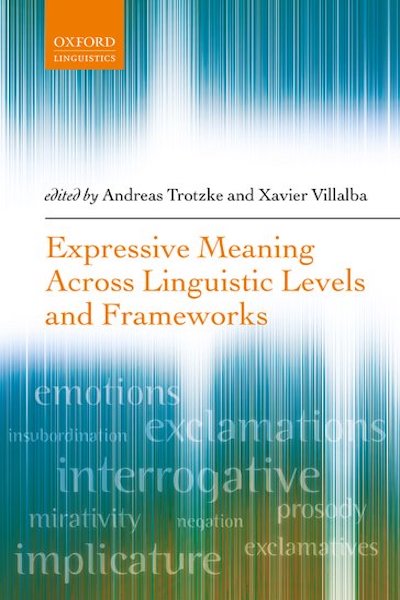
Andreas Trotzke & Xavier Villalba
Títol:
Expressive Meaning Across Linguistic Levels and FrameworksEditorial: Oxford University Press
Data de publicació: Agost del 2021
Pàgines: 336ISBN13: 9780198871217
Més informacióThis volume is the first to explore the formal linguistic expressions of emotions at different levels of linguistic complexity. Research on the language-emotion interface has to date concentrated primarily on the conceptual dimension of emotions as expressed via language, with semantic and pragmatic studies dominating the field. The chapters in this book, in contrast, bring together work from different linguistic frameworks: generative syntax, functional and usage-based linguistics, formal semantics and pragmatics, and experimental phonology. The volume contributes to the growing field of research that explores the interaction between linguistic expressions and the 'expressive dimension' of language, and will be of interest to linguists from a range of theoretical backgrounds who are interested in the language-emotion interface.
5 febrer, 2025

Autors:
Real, Espinal & Villalba
Títol:
Vaya in Spanish. From a judgment to a commitment markerEditorial: Journal of Historical Syntax
Data de publicació: 05-02-2025
Pàgines: 26 Més informació
Text completIn this paper we show the diachronic development of Spanish vaya, which goes from a form of the motion verb ir ‘to go’ to an epistemic verbal discourse marker (VDM) associated with the speaker's judgment regarding a proposition (e.g. ¡Vaya! ‘Wow!’ or ¡Vaya que es donoso! ‘How funny you are!’), and then to a VERUM marker (Leonetti & Escandell-Vidal 2009, Gutzmann, Hartmann & Matthewson 2017) encoding the speaker's strong commitment to the truth of a proposition (e.g ¡Vaya si se casa! ‘You bet he's getting married!’). We argue that this shift is a clear case of a run-of-the-mill process of grammaticalization involving three stages and each change corresponds to a different position of vaya in the articulated Speech Act layer advocated by Manfred Krifka (2021). When vaya expresses a subjective epistemic attitude of the speaker, it is postulated in J(udgement)P(hrase), a position associated with epistemicity and evidentiality; when vaya expresses a strong commitment of the speaker to the truth of the proposition it precedes (i.e., a VERUM marker), it is postulated in the higher Com(mitment)P(hrase). All in all, this study argues that the grammaticalization path of vaya is not only unidirectional (against previous analysis like Octavio de Toledo y Huerta 2001 and Company Company 2008), but rather obligatorily implies a bottom-up reanalysis (Roberts & Roussou 2003).
25 abril, 2024
Autors:
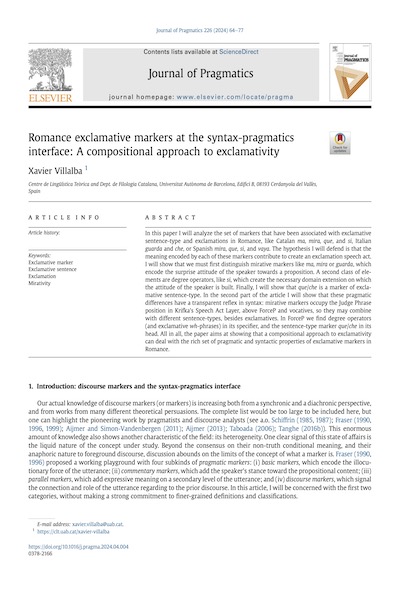
Xavier Villalba
Títol:
Romance exclamative markers at the syntax-pragmatics interface: A compositional approach to exclamativityEditorial: Journal of Pragmatics vol. 226 (Elsevier)
Data de publicació: Abril del 2024
Pàgines: 13 Text completIn this paper I will analyze the set of markers that have been associated with exclamative sentence-type and exclamations in Romance, like Catalan ma, mira, que, and si, Italian guarda and che, or Spanish mira, que, si, and vaya. The hypothesis I will defend is that the meaning encoded by each of these markers contribute to create an exclamation speech act. I will show that we must first distinguish mirative markers like ma, mira or guarda, which encode the surprise attitude of the speaker towards a proposition. A second class of elements are degree operators, like si, which create the necessary domain extension on which the attitude of the speaker is built. Finally, I will show that que/che is a marker of exclamative sentence-type. In the second part of the article I will show that these pragmatic differences have a transparent reflex in syntax: mirative markers occupy the Judge Phrase position in Krifka's Speech Act Layer, above ForceP and vocatives, so they may combine with different sentence-types, besides exclamatives. In ForceP we find degree operators (and exclamative wh-phrases) in its specifier, and the sentence-type marker que/che in its head. All in all, the paper aims at showing that a compositional approach to exclamativity can deal with the rich set of pragmatic and syntactic properties of exclamative markers in Romance.
15 febrer, 2024
Autors:
M.Teresa Espinal, Cristina Real-Puidgollers i Xavier Villalba
Títol:
From a movement verb to an epistemic discourse marker. The diachronic change of Spanish 'vaya'Editorial: Linguistic Variation (John Benjamins)
Data de publicació: Febrer del 2024
Pàgines: 36 Més informacióBesides its main use as a form of the movement verb ir ‘to go’, the Spanish form vaya (lit. go) is also used as a verbal discourse marker. Here we trace this transition from a purely verbal form to a discourse marker by searching a historical corpus of documents in Spanish, which reveals the increasing use over time of vaya in exclamatives to replace a presentational construction. We focus on vaya in isolation and in combination with an indefinite DP or a bare NP. We analyze the meaning of vaya as an epistemic discourse marker, by means of which the speaker expresses a judgment, a subjective epistemic and evidential evaluation of a proposition accessible from context. We postulate that these constructions sit in a Judgment Phrase at the syntactic-pragmatic interface (Krifka 2020), a position to which vaya also moves when its meaning is that of an expressive intensifier that directly modifies over one or more (contextually salient) properties of the noun contained in the DP/NP.