Ohannesian (2021). Interfixation

ohannesian 2021

Autors:

Maria Ohannesian

Títol:

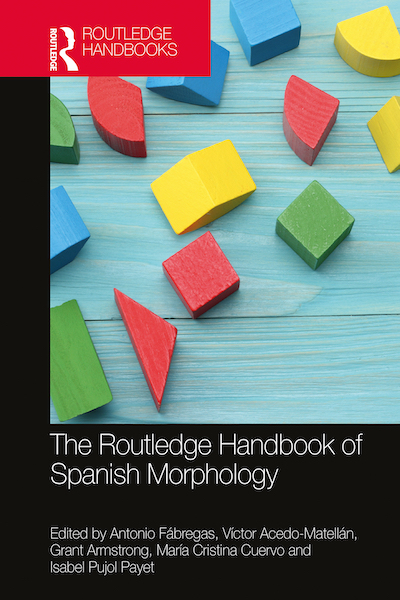
Interfixation. Dins Fábregas, Acedo-Matellán, Armstrong, Cuervo, Pujol (eds.) "The Routledge Handbook of Spanish Morphology"

Editorial: Taylor & Francis Group
Data de publicació: Maig del 2021
ISBN13: 9780429318191

Més informació

The Routledge Handbook of Spanish Morphology presents a state-of-the-art, detailed and exhaustive overview of all aspects of Spanish morphology, paying equal attention to the empirical complexities of the morphological system and the theoretical issues that they raise.
As such, this handbook is relevant both for those interested in the facts of Spanish morphology and those interested in general morphology that want to explore how the Spanish facts illuminate our understanding of human language and current theories of morphology.
This volume is also unique in its extent and coverage. Written by an international team of leading experts in the field, it contains 42 chapters divided into four sections, covering all synchronic and diachronic aspects of Spanish morphology, including inflection; derivation; compounding and other processes of word formation; the interaction of morphology with other modules of grammar and the role of morphology in language acquisition, psycholinguistics and language teaching.
Cabré, Teresa, Maria Ohannesian i Francesc Torres-Tamarit. 2026. Los verbos acabados en -uir y las desinencias verbales del español.

Autors:

Teresa Cabré, Maria Ohannesian, Francesc Torres-Tamarit

Títol:

Los verbos acabados en -uir y las desinencias verbales del español.

Editorial: Verba
Col·lecció:
Data de publicació: Juny 2026

Més informació

This paper proposes a morphological segmentation of the regular Spanish verbal paradigm that significantly simplifies its analysis. In the proposed model, the thematic vowel (TV) is always present in the underlying representation of all verbal forms of the three conjugations, either as stressed or as pre-accented. This analysis offers several advantages over more traditional approaches, such as those represented by recent grammars by the Royal Spanish Academy, since it allows the morphological structure of the three regular conjugations to be unified, including verbs whose root ends in a vowel, like those ending in -uir, with an /i/ following the root that has usually been analysed as an antihiatic epenthetic segment. The model also establishes that the thematic vowel of the first, second, and third conjugations is respectively /a/, /e/, and /i/ throughout the present stem and in forms historically derived from the infinitive. In the rest of the paradigm, the first conjugation maintains /a/, whereas the second and third display a common pattern with the alternation /i ~ je/, interpreted synchronically as allomorphy. Surface differences derive from general phonological principles of Spanish, in particular stress assignment and the productive process of stem-final vowel deletion. Tense-aspect-mood morphemes are also regularised.